Pure titanium (CP grades 1–4) and titanium alloys like Ti-6Al-4V (Grade 5) or Ti-3Al-2.5V (Grade 9) serve fundamentally different applications. CP titanium wins on corrosion resistance, biocompatibility, and food safety — making it the right choice for cookware, cups, and medical devices. Grade 5 alloy delivers 2.5× more tensile strength and suits structural, aerospace, and high-load components. Grade 9 sits in between and dominates the outdoor tubing market. Choosing the wrong grade costs you money, performance, or regulatory compliance — this guide shows you which is which.
At a Glance: Which Titanium Grade Do You Actually Need?
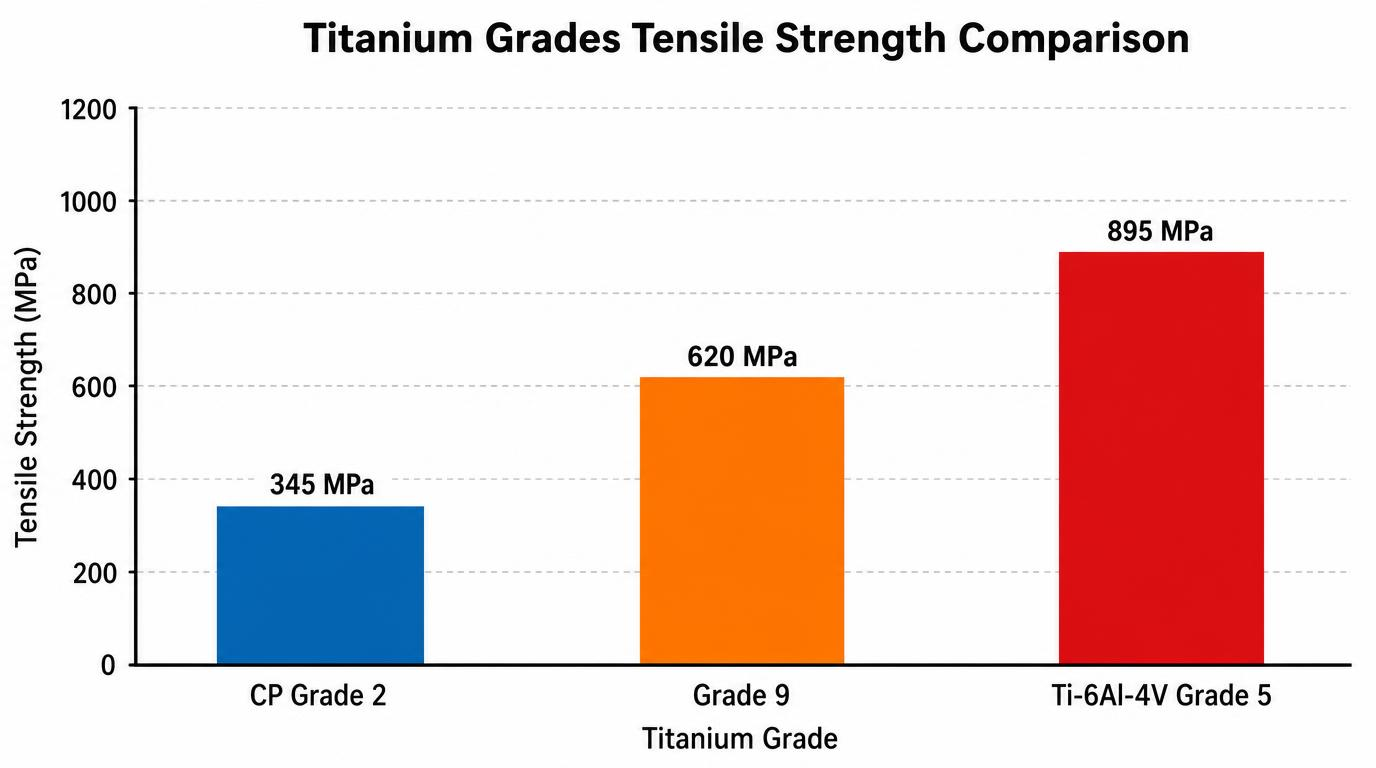
The single most important thing to know: “titanium” is not one material. ASTM recognizes 38+ titanium grades. For outdoor gear and industrial B2B sourcing, three matter most:
| Property | CP Titanium (Grade 1–2) | Grade 9 (Ti-3Al-2.5V) | Grade 5 (Ti-6Al-4V) |
|---|---|---|---|
| Composition | ≥99% Ti | Ti + 3% Al + 2.5% V | Ti + 6% Al + 4% V |
| Tensile Strength | 240–550 MPa | ~620 MPa | ~895 MPa |
| Density | ~4.51 g/cm³ | ~4.48 g/cm³ | 4.43 g/cm³ |
| Corrosion Resistance | Excellent | Very Good | Good |
| Biocompatibility | Highest | High | Limited (food contact: avoid) |
| Formability | High | Medium | Low |
| Weldability | Easy | Easy | Requires shielded atmosphere |
| Relative Cost | 1× | 1.3–1.5× | 2–3× |
| Typical Use | Cookware, cups, implants | Bike frames, tubing, outdoor tools | Aerospace, structural parts |
Sources: ASTM B265, urbanedc.com, dynamicmetalsltd.com, Smith Metal datasheet
If you’re sourcing for cookware or outdoor drinkware: Grade 1 or Grade 2 CP titanium.
If you’re sourcing for bike frames, poles, or thin-walled outdoor hardware: Grade 9.
If you’re sourcing for structural brackets, fasteners, or high-stress components: Grade 5.
What Is Commercially Pure (CP) Titanium?
CP titanium is ≥99% pure titanium, differentiated by trace oxygen and iron content across Grades 1–4. Grade 1 has the lowest impurity level (≤0.18% O₂) and is the softest and most ductile. Grade 4 has higher impurity tolerance and correspondingly higher strength — up to 550 MPa tensile — at the cost of some formability.
In practice, Grade 2 is the industrial workhorse: 345 MPa tensile strength, 275 MPa yield strength, 20% elongation minimum. It holds its shape under stamping and deep-drawing, which is why it dominates cookware and sheet-metal applications.
The oxide layer is the key advantage. When CP titanium contacts oxygen, TiO₂ forms on the surface within milliseconds. This self-healing passive film is what makes CP titanium resistant to saltwater, most acids, and chlorinated environments — Grade 2’s corrosion rate in wet chlorine is just 0.001 mm/year (NeoNickel technical data). No coating, no treatment required.
For food-contact and body-contact applications, Grade 1 is the standard precisely because no alloying elements are present. It’s the same material classification used in medical-grade dental implants and surgical devices. If a cookware brand is using Grade 1 and says so, that’s a meaningful claim.
What Is Titanium Alloy — and Why Does It Exist?
Titanium alloys add elements to boost specific performance parameters that CP titanium can’t achieve. The most important is Ti-6Al-4V (Grade 5): 6% aluminum raises the alpha-phase transition temperature and increases strength; 4% vanadium stabilizes the beta phase and improves heat treatability.
The result: Grade 5 achieves 895 MPa tensile strength — roughly 2.5× Grade 2 — at nearly the same density (4.43 g/cm³ vs 4.51 g/cm³ for CP). That strength-to-weight ratio is why Grade 5 accounts for approximately 50% of all titanium consumed globally and dominates aerospace, defense, and high-performance automotive sectors (Dynamic Metals Ltd).
Maximum service temperature also shifts significantly: CP titanium is rated to ~200°C in normal atmosphere; Grade 5 performs to ~400°C, which matters for engine components and exhaust systems.
The trade-off is fabrication complexity. Grade 5 cannot be cold-formed like CP titanium without cracking risk. Welding requires shielded atmosphere to prevent embrittlement. Machining cycle times are longer, tool wear is higher, and all of this flows downstream into higher part cost — typically 2–3× more than equivalent CP titanium products.
The Outdoor Middle Ground: Grade 9 (Ti-3Al-2.5V)
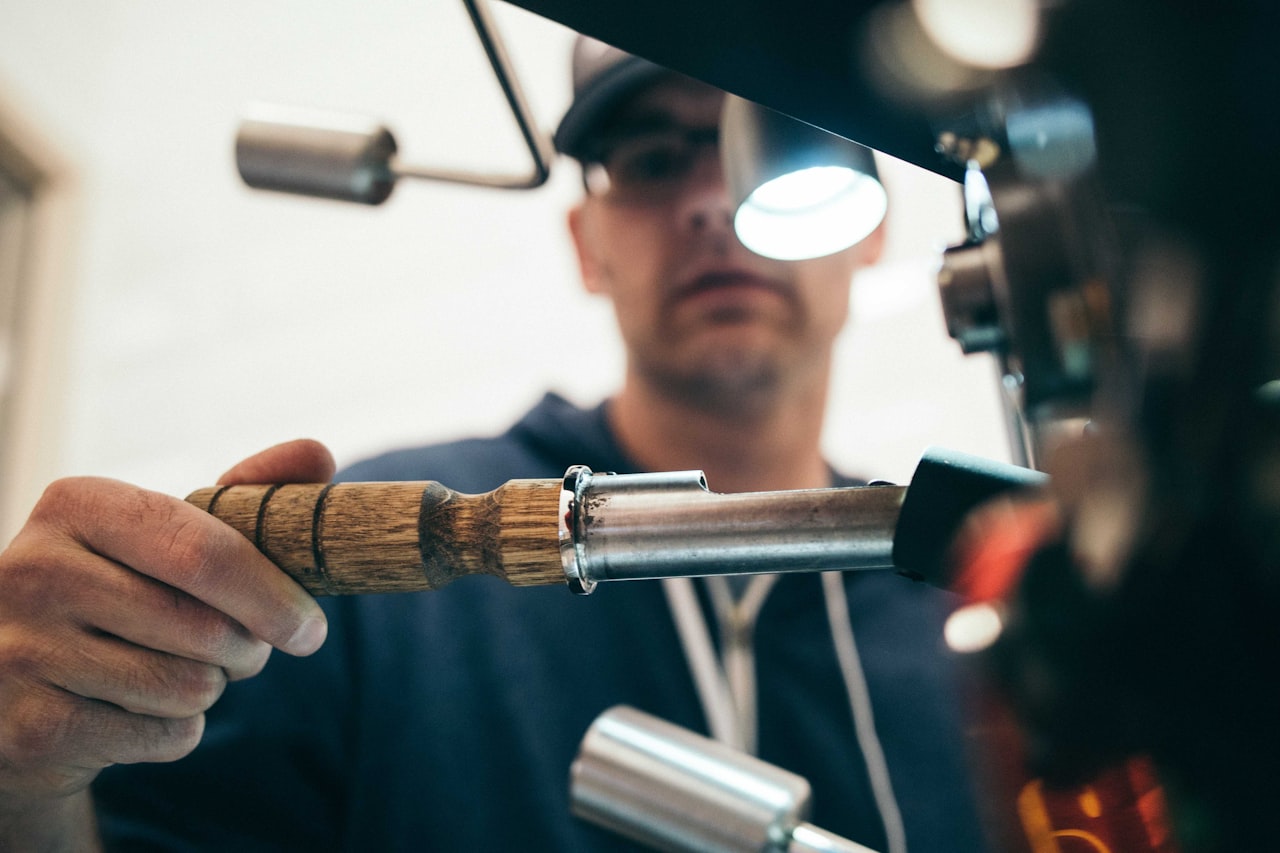
Grade 9 is the grade most outdoor manufacturers never tell you they’re using — but probably should. It’s a near-alpha alloy with 3% aluminum and 2.5% vanadium, sitting squarely between CP and Grade 5: 620 MPa tensile strength, cold-formable, weldable without a vacuum chamber, and 20–50% stronger than Grade 2.
The cycling industry figured this out years ago. Enigma Bicycle Works calls Grade 9 “the workhorse of titanium bike building” — most high-end titanium frame tubing is Grade 9, not Grade 5, because it balances wall-thickness reduction against cold-working constraints. Grade 5 would be overkill structurally and a nightmare to form into thin-walled tubes.
For outdoor gear manufacturers, Grade 9 makes sense for:
- Tent poles and trekking poles (thin-walled, weight-critical, impact-loaded)
- Cutlery handles and tool frames (higher wear resistance than CP)
- Water bottle bodies where wall reduction is a design priority
The vanadium content in Grade 9 is lower than Grade 5 (2.5% vs 4%), and while it’s not the preferred food-contact material, short-term contact in well-finished products carries low practical risk. That said, for anything with prolonged food contact — pots, cups, bowls — CP titanium remains the correct choice.
The Food Safety Question No One Answers Directly
Buyers ask this constantly, and most articles sidestep it: Is Ti-6Al-4V (Grade 5) safe for cookware?
The honest answer: Grade 5 is not recommended for direct, prolonged food contact.
Vanadium is a transition metal with cytotoxicity at elevated concentrations. Aluminum, while present in trace amounts in alloy, is not a food-safe additive. The passive oxide layer on Grade 5 is protective under normal conditions, but elevated pH, acidic foods (tomato sauce, vinegar), high heat, and surface damage can compromise it.
This is why specialist cookware brands like Valtcan explicitly use Grade 1 and state it publicly. It’s not just marketing differentiation — it’s sound materials practice. The implant industry, which faces similar contact duration and body-chemistry considerations, also uses CP grades (Grade 1 and Grade 23 ELI) rather than Ti-6Al-4V for direct tissue contact.
For a B2B buyer sourcing cookware or drinking vessels: require the supplier to state the grade in writing and back it with a mill certificate. If the answer is “titanium alloy” without grade specification, that’s a red flag worth addressing before production starts.
Corrosion Resistance: Where CP Titanium Has No Rival
CP titanium’s corrosion performance is exceptional — and Grade 5’s is merely good. In marine environments, chemical processing, and outdoor exposure to salt, moisture, and UV, CP titanium’s homogeneous oxide layer outperforms alloys because there are no second-phase particles or compositional gradients to create galvanic micro-cells.
Grade 5 is still far more corrosion-resistant than stainless steel in most environments. But when you need demonstrated resistance across a wide pH range, chemical media, or long outdoor service life — Grade 2 is the technically superior choice.
In my review of performance data from NeoNickel and Dynamic Metals, the most consistent differentiator is this: CP titanium’s oxide layer is self-healing across the widest range of conditions. Grade 5’s oxide layer is protective too, but the alloying elements can introduce localized vulnerability in specific aggressive media — something a buyer sourcing for outdoor or marine applications should factor in.
Weight: The Number Everyone Gets Wrong
ほとんどの製品において、CPチタンとグレード5の重量差は無視できるレベルです。.
グレード2の密度:4.51 g/cm³
グレード5の密度:4.43 g/cm³
その差はわずか1.8%です。重量80グラムの300mlキャンプ用カップの場合、差は1.5グラム程度であり、製造公差のばらつきの範囲内に十分収まります。.
重量に関する本質的なポイントは 強度によって可能になる肉厚. にあります。グレード5は2.5倍の強度を持つため、設計者は構造的に同等な部品に対してより薄い肉厚を指定できます。ただし、これは荷重を受ける部品にのみ関係する話であり、薄肉の調理器具やカップでは、制約となるのは構造荷重ではなく取り扱い時の剛性であるため、該当しません。.
アウトドア用調理器具や飲料容器では、標準板厚のCPチタンが実用上同等かそれ以上に軽量です。 荷重リスクなしにより薄く加工でき、密度によるペナルティもごくわずかであるためです。.
B2B調達:チタンサプライヤーに確認すべき3つの質問
市場に出回っているチタン製品のほとんどは、グレードを明示せずに「チタン」と表示されています。B2Bバイヤーにとって、グレードの曖昧さは、コンプライアンス違反、バイヤー監査での不合格、製品返品というリスクに直結します。.
注文前に、以下の3つの質問をしてください。
「この材料はどのASTMグレードですか?ミル証明書を提出してもらえますか?」“
正当なメーカーであれば、グレード1、2、4、5、9、またはその他の特定グレードを回答し、文書で裏付けます。「高級チタン」や「純チタン合金」といった回答は答えになっていません。それはごまかしです。.
「酸素含有量の仕様はどうなっていますか?」“
これはCPグレードで最も重要です。グレード1はO₂ ≤0.18%、グレード2は≤0.25%です。酸素含有量が高いと強度は上がりますが、延性と耐食性は低下します。酸素仕様を把握しているサプライヤーは、実際の工程管理に基づいて対応しています。.
「食品接触適合性の試験は実施されていますか?」“
調理器具、カップ、および食品や飲料に接触するあらゆる製品については、溶出試験または食品接触適合性の文書を求めてください。CPグレード1または2は容易に合格します。グレード5は、サプライヤーが調理器具でコスト削減のために使用している場合、リスク要因となります。.
実用アプリケーションマトリックス
| 用途 | 推奨グレード | 理由 |
|---|---|---|
| キャンプ用調理器具(鍋、フライパン) | グレード1 CP | 食品に安全、成形性に優れ、溶出リスクなし |
| チタンカップ/マグ | グレード1または2 CP | 生体適合性が最も高く、深絞り加工が容易 |
| キャンプ用カトラリー | グレード2 CP | 延性と硬度のバランスが良好 |
| トレッキングポール/テントポール | Grade 9 | CPより高強度、冷間成形可能なチューブ |
| 自転車フレーム | Grade 9 | チューブ成形の業界標準 |
| アウトドア用ファスナー/金具 | Grade 5 | 高い疲労強度が必要 |
| 航空宇宙用ブラケット | Grade 5 | 最高の強度対重量比が要求される |
| 医療・歯科用インプラント | グレード1またはグレード23 ELI | 最大限の生体適合性 |
| 船舶用熱交換器 | グレード2 CP | 塩水中での最高の耐食性 |
よくある質問
チタン合金は純チタンより強いですか?
はい、大幅に強いです。Ti-6Al-4V(グレード5)は約895 MPaの引張強度を達成しますが、グレード2 CPチタンは約345 MPaであり、およそ2.5倍の強度です。グレード9(Ti-3Al-2.5V)はその中間の約620 MPaです。.
アウトドア用調理器具に最適なチタンはどれですか?
商業用純チタン、具体的にはグレード1またはグレード2です。これらのグレードは溶出する合金元素を含まず、薄肉形状への成形が容易で、食品の酸や屋外環境による腐食に耐性があります。.
Ti-6Al-4V(グレード5)は食品接触用途に安全ですか?
食品との長時間の接触には推奨されません。バナジウムとアルミニウムの含有により、酸性または高温条件下で溶出リスクが生じる可能性があります。調理器具や飲料容器にはCPグレードが正しい選択です。.
自転車フレームにはどのチタングレードが使われていますか?
ほとんどの高級チタン製自転車フレームには、グレード5ではなくグレード9(Ti-3Al-2.5V)が使用されています。グレード9はCPチタンより20~50%高い強度を持ちながら、冷間成形が可能で、薄肉チューブへの溶接も容易です。.
製品に使用されているチタンのグレードを確認するにはどうすればよいですか?
サプライヤーにミル証明書または分析証明書(COA)を依頼してください。製品にグレードを明記せず「チタン」とのみ記載されている場合は、メーカーに問い合わせてください。信頼できるサプライヤーであればASTMグレード番号を提示できます。.
チタン合金は溶接できますか?
グレード9とCPグレードは比較的容易に溶接できますが、チタンは常に清浄な環境(酸素汚染なし)が必要です。グレード5の溶接にはシールド雰囲気管理が必要で、可能ではありますが、より工程集約的でコストも高くなります。.
まとめ
チタンはグレード間で互換性がありません。アウトドア用品の調達およびB2B製造において、, グレードを正しく選ぶことは、素材を正しく選ぶことと同じくらい重要です.
CPチタン(グレード1~2)は、成形性、食品安全性、耐食性の組み合わせにおいて他に匹敵するものがないため、調理器具、飲料容器、医療機器の分野を担っています。グレード9は、アウトドア用チューブや自転車フレームにおける陰の立役者であり、ほとんどのバイヤーが存在を知らずに見過ごしている実用的な中間グレードです。グレード5は航空宇宙を可能にする高性能合金ですが、キャンプ用マグカップではなく構造部品に使用されるべきものです。.
サプライヤーとのやり取りや仕様書を通じて一貫して見られるパターン: グレードを指定するバイヤーは、より良い製品を入手でき、コンプライアンス上の予期せぬ問題が少なく、サプライヤーの説明責任も強化されます。. ASTMグレードとミル証明書を求めてください。3秒の会話で、多くの高額な問題を防ぐことができます。.